Camaraderie
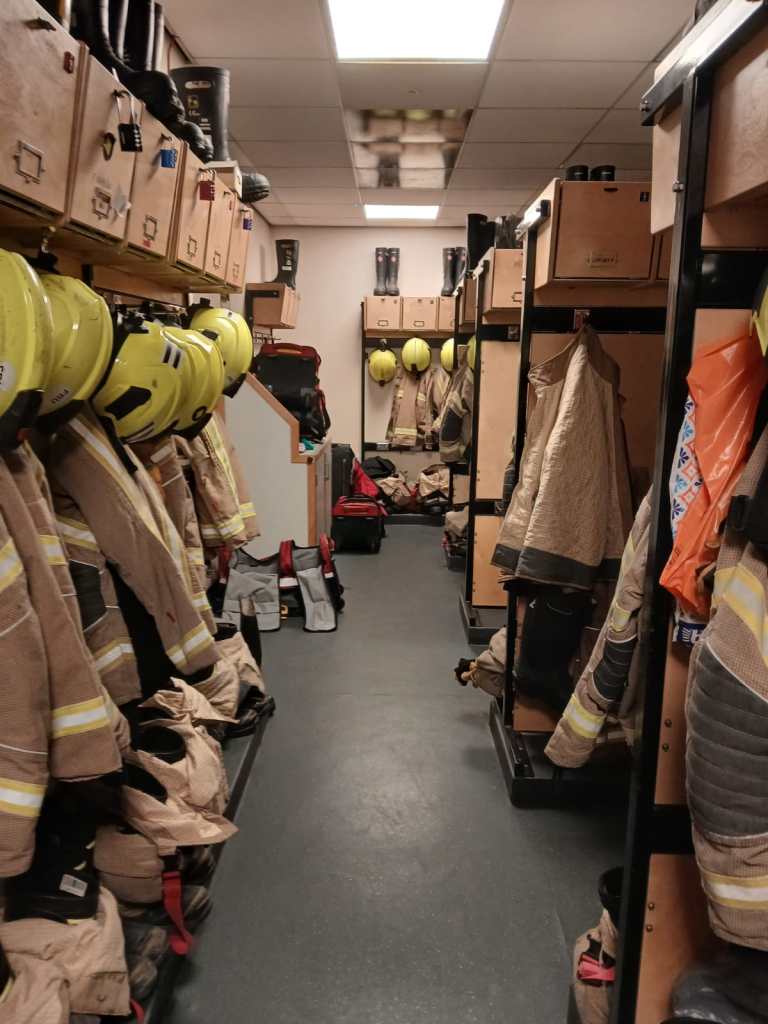
Teamwork is crucial for first responders when working under pressure in potentially dangerous environments. I asked them what they do to strengthen their team bond.
As Tom put it, “Food is the big thing.”
“The heart of the watch is the kitchen,’ Dominic said. “We all sit down around the table together. There’s no rank in the mess.”
The watch (a team of firefighters) shared that everyone pitches in to cook, making it a group effort. On the evening of our chat, Baran was the cook for the night as the mess manager was elsewhere. They all reiterated that mealtimes could get quite boisterous, with plenty of laughs and banter around the table.
During the tour, Tom opened one of the fridges to reveal the salad drawer stuffed with Mars bars and the shelves packed with drink cans to fuel them through their shifts. They explained that the kitchen sometimes had cakes which firefighters brought in.
Ricky pointed out that, although mistakes were quickly forgiven, there was an unspoken rule among the watch:
“Make a mistake, you bake a cake,” Dominic joked.

The team building clearly paid off – there was an undeniable bond among them. Banter flew like bullets across the room, and it could be difficult to tell where one joke ended and another began.
Ricky deadpanned that her pet parrot offered more stimulating conversation than the “toddlers” she worked with.
The room laughed, and Tom chimed in, noting that the job demanded a strong, dark sense of humour – and, presumably, a thick skin for friendly fire.
When asked whether they worked just as well with other emergency services, Dominic said that there is a lot of teasing between them.
“[The police] get upset when we ask them how much sleep they had the night before; [firefighters] get a lot of flak for supposedly ‘sleeping on nightshifts’,” he added with a grin.
He then offered a more grounded view. “We work quite well together. At major incidents, the senior officers will have multi-agency meetings every hour to discuss strategy, but generally, when you turn up at a job, everyone seems to know what they are doing.”
Multi-agency meetings refer to coordinated discussions between emergency services, such as the police, the ambulance, and fire rescue services, held during major incidents. [2]
Tom reiterated the seamless teamwork between the services. “At emergencies like roadside collisions,” he said, “working together feels natural.” He described that in a situation like a cardiac arrest, “a firefighter and a police officer might take turns doing chest compressions while the paramedics prep their equipment.”
At certain incidents, emergency response teams sometimes employ dogs for their superior sense of smell.
Dogs have approximately 40x the number of olfactory (smell) receptors as humans, enabling them to identify substances and find people quickly. [3]
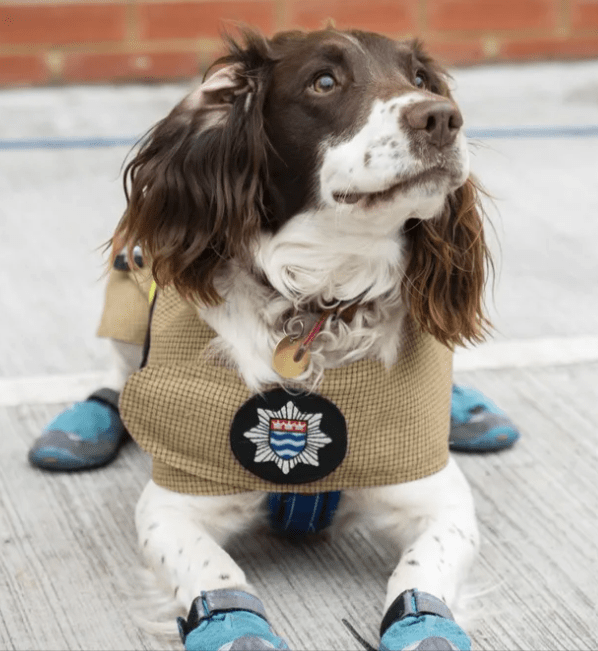
When asked whether there were any animal firefighters, Tom pulled out his phone and showed me a picture of the two fire and rescue dogs, Simba (see below) and Smokey.
These dogs are trained to “sniff out ignitable substances” faster than humans and current technologies, aiding in the determination of whether fires are caused by arson or by other means. [4]
Tom fondly pointed out the dog’s shoes, which protect its feet from burns. Baran explained that specialised handlers bring in the dogs for “complicated incidents where powerful noses are needed”.
Click to view references
[1] Taylor, N. (2025, April 29). Interview with Euston firefighters [Interview].
[2] NHS England. (2025) Incident Response Plan (National). Version 5.0. Available at: https://www.england.nhs.uk/wp-content/uploads/2017/07/PRN02102-incident-response-plan-v5.pdf (Accessed: 1 August 2026).
[3] Kumar, A. (2022). The role of dogs in search and rescue. In S. Verma & H. T. Prem (Eds.), Management of animals in disasters (pp. 177–188). Springer. https://doi.org/10.1007/978-981-16-9392-2_16
[4] London Fire Brigade, Fire investigation search dogs [online]. Available at: https://www.london-fire.gov.uk/about-us/services-and-facilities/vehicles-and-equipment/fire-investigation-dogs/


Leave a Reply