Wednesday, 18:15 – 20:30, the 12th of August 1
On Wednesday evening, 12 August, a partial eclipse was visible across the UK. In my hometown, dozens of families gathered in anticipation in a public park, sitting on blankets, with their eclipse glasses and homemade pinhole projectors. Over the next hour, we watched the Moon slowly slide a path across the Sun, the evening air cooling as the sunlight dimmed.
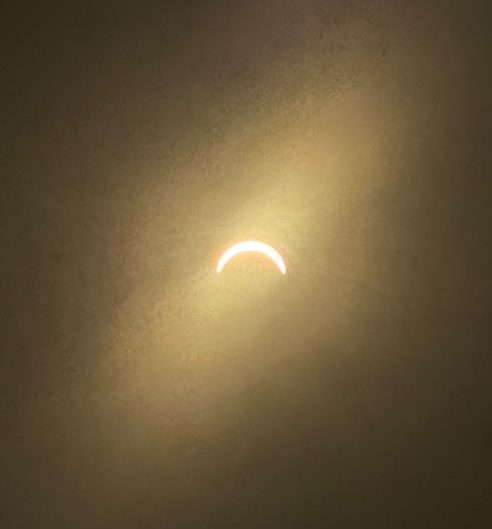
A solar eclipse occurs when the Moon passes directly between the Sun and the Earth, casting the Earth in shadow.2 During a solar eclipse, the Moon’s shadow (umbra) covers 250 km of the Earth’s surface. A partial eclipse occurs in the lighter part of the Moon’s shadow (penumbra).3. Due to the Moon’s orbit being at an angle to the Earth, an eclipse only occurs once every 18 months.
Earth is the only rocky planet in our solar system that experiences total solar eclipses, made possible because the Sun and Moon appear approximately the same size when viewed from Earth. The Sun is 400 x larger than the Moon, but the Moon is 400 x closer to Earth.4 5
In the UK, the eclipse reached 90-96% coverage and lasted around 1 hour 50minutes. 6 However, total eclipses did occur in Russia, Greenland, Iceland, Spain, and Portugal. Unfortunately, a total solar eclipse will not occur in the UK until 2090, and the last one was in 1999. 7
History
The earliest known recordings of solar eclipses date back to 3340 BCE, in Ireland, where petroglyphs (stone carvings) show “overlapping concentric circles” depicting an eclipse. 8 There are also written records on clay tablets from 1223 BCE in Syria 9 and on oxen bones and tortoise shells from 1200 BCE. 10
In 700 BCE, Babylon (present-day Iraq) astronomers created the Saros series, which calculates recurring eclipses every 18 years and 11.3 days.1 11 Before modern astronomical ephemerides (mathematical models), it was a fairly accurate way of plotting when an eclipse was to occur.12
Solar eclipses provide astronomers the opportunity to observe the solar corona (the Sun’s outer rim), and solar wind escaping from the Sun’s surface. 13 14 Aeroplanes have been utilised to collect eclipse data since 1925 as they remove atmospheric disruption and extend the corona’s observable time by keeping pace with the Moon’s umbra (‘chasing its shadow’).
The longest airborne total eclipse ever recorded was 74 minutes, made possible by a Concorde jet in June 1973.15 During the 12th of August eclipse, NASA’s WB-57n extended observable eclipse totality to 3 minutes off the coast of Iceland, whilst everybody else witnessed less than 2.5 minutes of totality.16
Religion & Folklore
Mapping celestial movements has been a tool cultures have used to navigate and record time across calendars and seasonal changes, contributing to the success of human activities such as farming and sailing. Stories developed alongside these skills for reading the celestial bodies seen from Earth and are used to understand both their movements and the world around us. 17
A Cherokee American folktale tells the story of a giant frog swallowing the Sun; the Cherokee would then shoot guns or beat drums to scare the frog away.18 During a Solar eclipse, Navajo Americans remain inside their hogan (traditional dwelling) to prevent people from looking into the Sun and to recognise it as a time for celestial bodies to realign. 19 Similarly, the mythology of a giant frog eating the Sun is also found in Vietnam. 20
In ancient China, it is the Great Dragon that comes out to devour the Sun whilst other legends stated it was a celestial dog; citizens would shout and ring gongs to scare the beast away. 21 Records of solar eclipses have been found dating back to 1200 B.C.E. on tortoise shells and oxen shoulder bones.22
In Korea, folklore speaks of a King who orders “fire dogs” to steal the Sun and Moon; they fail to do so, but occasionally an eclipse occurs when the dogs get close enough to bite them. 23 Similarly, in Norse mythology, the sky wolves (Skoll & Hati) – created by the god Loki – chase Sol and Mani, the goddess of the Sun and god of the Moon.24 An eclipse occurs when one of these gods is caught.
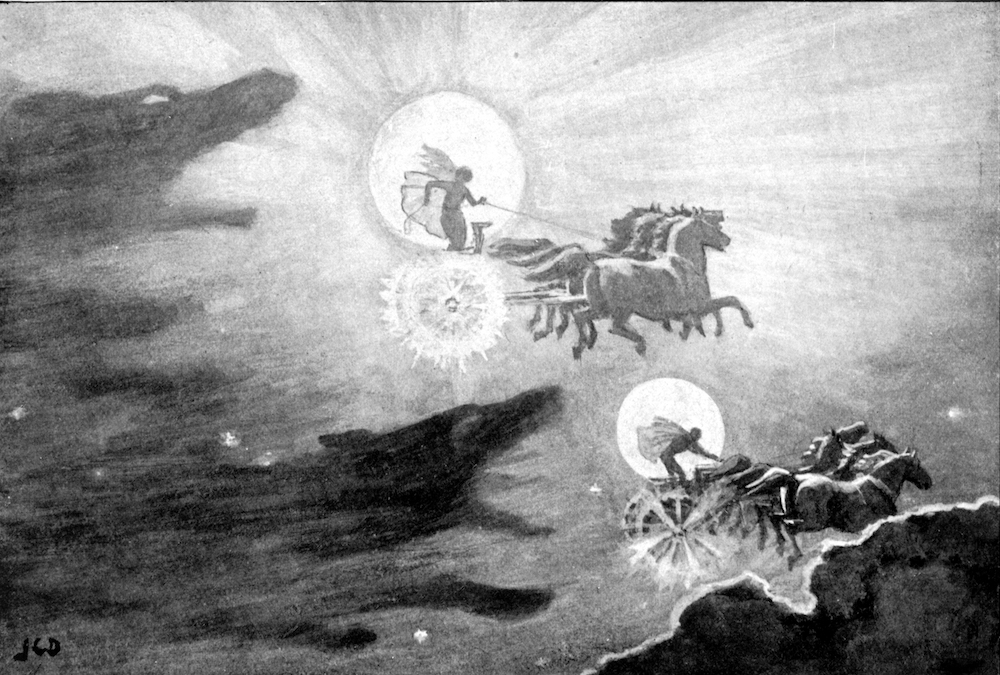
Other cultures depict fleeting meetings between family members. The Inuit believe that the Sun is the Goddess Malina, who escaped her brother Annigan after he assaulted her. 25 She fled from him into the night sky where he pursued her; it is only at an eclipse that they meet. Meanwhile, the Warlpiri Aboriginal Australians depict the Sun and Moon as man and wife who come together at an eclipse to make love. 26
Cultures from around the world explain the phenomenon of the Sun disappearing through stories of it being devoured by mythical beasts or through the intimate meetings between anthropomorphised celestial bodies. 27 28 It comes as no surprise that these stories evolved to reflect what was common or important to each culture. 29
However, it is the similarity between these stories which leads us to question the universality of human psychology. Whilst some stories evolve through cross-cultural exchange, others are built through the shared human experience of emotions and life milestones, and the significance of storytelling traditions for our cultures.30
Overview
Ultimately, it is universal across our species that we exhibit a drive to understand our world. Albeit for practical purposes or simply for our own satisfaction, eclipses have been studied by astronomers and laymen alike for thousands of years, demonstrating our human fascination for the natural patterns that occur around us.


Leave a Reply