Diwali
Last October, I was invited to celebrate Diwali with a friend’s family – an exciting opportunity to take part in a festival that, as a non-Hindu, I had previously felt unable to share in.
On the drive over, strings of lights decorated the occasional house, a clear sign that others were also celebrating. Once there, her family welcomed me into their home, explaining that Diwali was a day to share with friends and family, even if they are not Hindu.
All the ladies wore brightly-coloured sarees (one-piece draped robes), and to include me further, I was lent a pink lehenga (a skirt and blouse). Pictured behind me, the family’s home altar holds icons of deities, incense, and sacred books; most Hindu families have home altars for regular, private and family prayer (more on shrines later). [1]
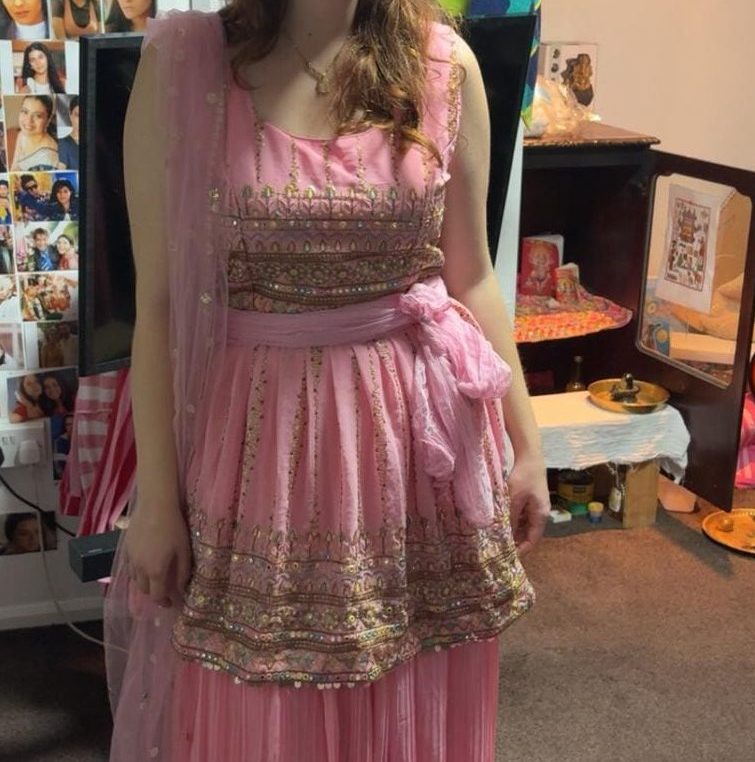
Diwali (‘festival of light’) or Deepavali (‘row of lit lamps’) celebrates the triumph of good over evil, the defeat of the demon Ravana (more on this later), and to usher in prosperity for the coming year. [2] [3] [4] On the Hindu lunar-solar calendar, this five-day festival coincides with the longer autumnal nights, with the main festivities occurring on the 3rd day with the new moon.
Hinduism is the oldest, ongoing religion in the world, originating in the Indus River valley 4,500 years ago, alongside the ancient Indus civilisations including the Mesopotamians and ancient Egyptians. [5][6]. Hinduism’s start date and its existence as a religion are highly debated, and hindered by the word’s colonial usage to group a plethora of non-Abrahamic religious practices into a single category.
Today, Hinduism is deemed the third largest religion in the world, with approximately 80% of India’s population being Hindu and a worldwide following of over 1.15 billion. [7]
This 4-part article series will cover Stories of Diwali (incl. the Ramayana), Shrines & Deities, Puja (Devoted, Ritual Worship), and the Other Festivities which occur on Diwali.
Click to view references
[1] Vanishing Arts Gallery, 2024. Hindu Home and Temple Shrines and Religious Practices. [online] Vanishing Arts Gallery. Available at: https://vanishingarts.gallery/hindu-home-and-temple-shrines-and-religious-practices-2/ [Accessed 2 August 2026].
[2] Mata Amritanandamayi Math, 2026. Deepavali – the festival of Lights: the legends, story and the message of Diwali. [online] Online with Amma. Available at: https://www.amritapuri.org/3575/deepavali.aum [Accessed 2 August 2026].
[3] Royal Museums Greenwich, 2026. Diwali dates, celebrations and traditions. [online] Royal Museums Greenwich Stories. Available at: https://www.rmg.co.uk/stories/time/when-diwali [Accessed 2 August 2026].
[4] Gettysburg College (2026) What is Hinduism? Available at: https://www.gettysburg.edu/offices/religious-spiritual-life/world-religions-101/what-is-hinduism (Accessed: 1 August 2026).
[5] BBC, 2009. History of Hinduism. [online] Available at: <https://www.bbc.co.uk/religion/religions/hinduism/history/history_1.shtml> [Accessed 2 August 2026]
[6] International Mission Board (2018) The story and spread of Hinduism. Available at: https://www.imb.org/2018/08/10/the-story-and-spread-of-hinduism/ (Accessed: 1 August 2026).
[7] Hoiland, S. (n.d.) Hinduism, Introduction to Sociology. Lumen Learning. Available at: https://courses.lumenlearning.com/wm-introductiontosociology/chapter/hinduism/ (Accessed: 2 August 2026).


Leave a Reply