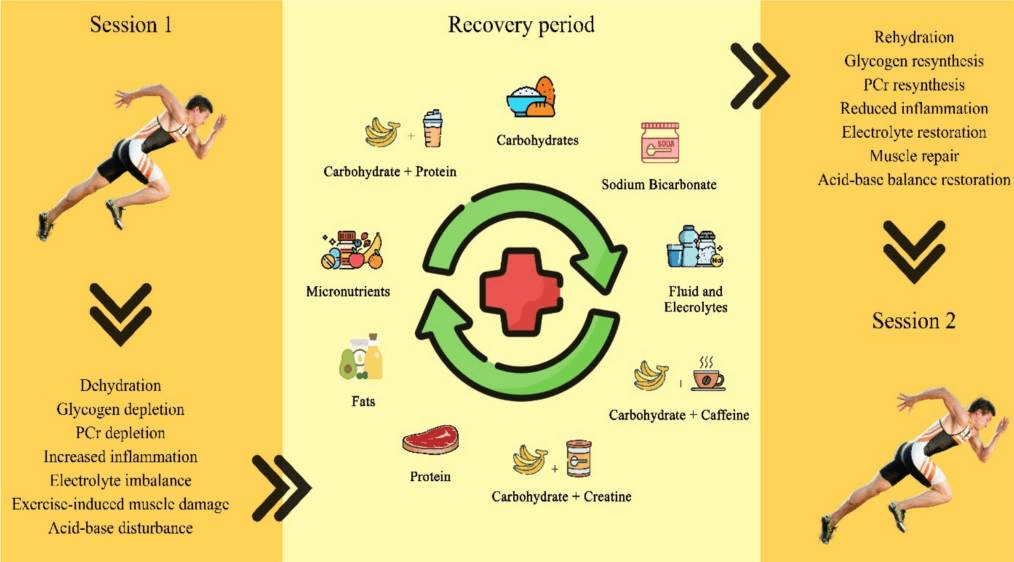
[3] Naderi, A., Rothschild, J.A., Santos, H.O., Hamidvand, A., Koozehchian, MS., Ghazzagh, A., Berjisian, E. and Podlogar, T., 2025. Nutritional Strategies to Improve Post-exercise Recovery and Subsequent Exercise Performance: A Narrative Review. Sports Medicine, 55(7), pp.1559–1577. Available at: https://pmc.ncbi.nlm.nih.gov/articles/PMC12297025/#Bib1. Image altered for the purpose of this post – cropped only. https://creativecommons.org/licenses/by/4.0/
Yesterday, I was doing some research about carb intake for training.
- 1 hr before running, consume 1g carb/kg body weight. [1].
- During runs of 1.5-2.5hrs, consume 30-60 g carbs/hr; for a marathon, 60-90 g/hr [1, 2].
- Post-exercise, consume 1–1.2g/kg body weight/hr during the first 4 hours [3]
Which means, I haven’t been eating enough carbs. Not nearly enough.
So, after the run, I doubled my carbs – having 3 sandwiches within 4 hrs. Not kidding. During, I had 9 jelly babies; this should’ve been double. 22km = 2.5hrs max should be 8/hr (4 sweets = 16.1g carb). For the marathon, 15/hr, consuming 4 every 15 minutes.
I also heated my calves with two hot beanies and elevated my feet. Afterwards, the customary leg ache was much reduced, although more localised around the knees and outer hips (probably early indicators of my previous injuries).
I suffered no fatigue.
Next steps: Invest in compression socks for recovery periods, wear knee tape, begin strengthening exercises for hip flexors.
References
 Waygaze
Leave a comment