
Types of writing systems, how they work, and whether and how they relate to their spoke mode of their respective languages.
In this essay, I will compare the writing systems employed in British English and Japanese. Specifically, I will be describing the type of systems they are, how they work, and how they relate to their spoken forms. I have italicised rōmaji (a Japanese script of Roman letters) to demonstrate the
pronunciations of Japanese words which are also spelt in their appropriate script (either Kanji or kana). I have also demonstrated Japanese translations in [square brackets]. An example of this would be: 私の猫の名前はムーンライトですwatashi no neko no name wa Mūnraito desu [My cat’s name is Moonlite]. Differently, English examples have both inverted commas and italics, for example, ‘My Cat’s name is Moonlite’.
Types of writing systems and how they work
Scripts
According to DeFrancis (2002), there are two types of writing systems: pleremic and cenemic. Pleremic writing utilises semantically informed graphic units to indicate sound and meaning, whilst cenemic writing has graphic units without semantic meaning and only represents sounds. These two systems can be further divided into three classifications, logographic, phonographic or syllabic types, although variants exist (Coulmas, 2010). Any of these systems can make use of more than one type (DeFrancis, The ideographic myth, 2002).
DeFrancis (1989) described English as a morpho-phonemic system. English has a 26-letter alphabet deriving from the 23-letter Roman alphabet with an additional three letters added over the years(Crystal, 2003). These letters, or graphemes, are the basic elements of the English writing
system and have no meaning themselves until they are combined with other letters to form words (Crystal, 2003). The English alphabet is therefore of the cenemic system.
Conversely, Japanese is made up of both a pleremic and cenemic system. Japanese is a multi-script writing system which includes 漢字 kanji, a script which is primarily representative of morphemes and therefore is a morphographic writing system (Borgwaldt & Joyce, 2013). Kanji are used to form poly-morphic words or are followed by okurigana, forming inflexions of adjectives and verbs (Borgwaldt & Joyce, 2013). For example, 新幹線 shinkansen [Bullet train] is a polymorphic word formed with three kanji, literally meaning ‘New trunk line’, an example of okurigana (underlined) combining with kanji is in the verb 食べます tabemasu [to eat]. Therefore, as a morphographic system, kanji is pleremic.
Alternatively, there are two syllabaries called 平仮名 hiragana and 片仮名 katakana, collectively known as kana (Borgwaldt & Joyce, 2013). As stated by Sakade (2013), hiragana is used to replace complex kanji like 鸚鵡 ōmu [parrot] to become オウム, and is also used for verb inflexions and grammatical particles. Sakade (2013, p.ix) also states that “Katakana is more angular in appearance than hiragana and today are used primarily for loan words of European origin, e.g., パン pan [bread] or ビール biiru [beer]”. As explained by Trombley and Takenaka (2015), portions of kanji make up katakana and simplified kanji forms of hiragana. As both scripts are syllabaries there are part of a cenemic system.
These three scripts make up modern written Japanese (Tamaoka, 2014). For example, 私 はカナダに行きます [I am going to Canada] ({Ajalt}, 1994), Kanji (underlined), hiragana in okurigana ききま and particles は and に, and katakana in カナダ[Canada].
Two other scripts are also used in Japanese, Romaji ローマ字, an alphabetised script used for transcribing Japanese words into Roman letters (Tamaoka, 2014), and 振り仮名 furigana, used to indicate readings for kanji commonly found in newspapers (Borgwaldt & Joyce, 2013). For example, 私わたし watashi [I] instead of 私.
Structure of sentences
English is an SVO language, in that its elements usually follow a subject, verb, object word order (Crystal, 2003). For example, ‘I went to the shops’ demonstrates this, where the verb ‘went’ (underlined) comes between the subject ‘I’ and the object ‘the shops’. Despite SVO being the predominant structure in English, there are other constructions. Crystal (2003) provides another sentence structure, SVC (subject, verb, complement), where complements give additional information about the subject or object; ‘I am happy’ would be an SVC with the adjective ‘happy’ providing information about the subject ‘I’. Another construction in English is found in ‘Here comes the bus’, where the verb ‘comes’ precedes the subject ‘the bus’ (Graddol, Leith, & Swann, 2000).
Unlike English, Japanese uses a SOV structure, with the “verb generally coming at the end of the sentence or clause (Ajalt, 1994). For example, 私は水を飲みますwatashi wa mizu o nomimasu [I drink water], the verb has been underlined, and the subject 私 [I] and object 水[water] precede it. Japanese also uses complements, for example 私は日本―人です watashi wa Nihon-jin desu‘ [I am Japanese] ({Ajalt}, 1994).
According to Aronoff and Rees-Miller (2003) , subjects are essential to English sentence structures but not to Japanese. The example below demonstrates Japanese dropping the subjects whilst the English equivalent keeps them (subjects are underlined):
“…ブラウンさんは毎朝コーヒーを飲みますが、何も食べません。そして新聞を読みます。地下鉄で会社に行きます。時々地下鉄で本や雑誌を読みます 。
…‘Buraun-san wa maiasa kōhī o nomimasu ga, nani mo tabemasen. Soshite shimbun o yomimasu. Chikatetsu de kaisha ni ikimasu. Tokidoki chikatestsu de hon ya zasshi o yomimasu.’
…[Mr. Brown drinks coffee every morning, but doesn’t eat anything. And then he reads the paper. He goes to his office by subway. Sometimes he reads a book or magazine on the subway.]…”
({Ajalt}, 1994, pp. 85-86)
In the Japanese example, the subject is dropped from all but the first sentence; the second sentence translates to ‘And then reads a newspaper’.
Unlike English, Japanese uses particles to indicate topics and objects. Trombley and Takenaka (2015) state that common topic markers include は wa orが ga, and common object markers include をo and にni (indirect object). Particles in the Japanese example above have been put in bold. Other particles shown include もmo, acting as a negation marker like English’s particle not.
Layout of Writing
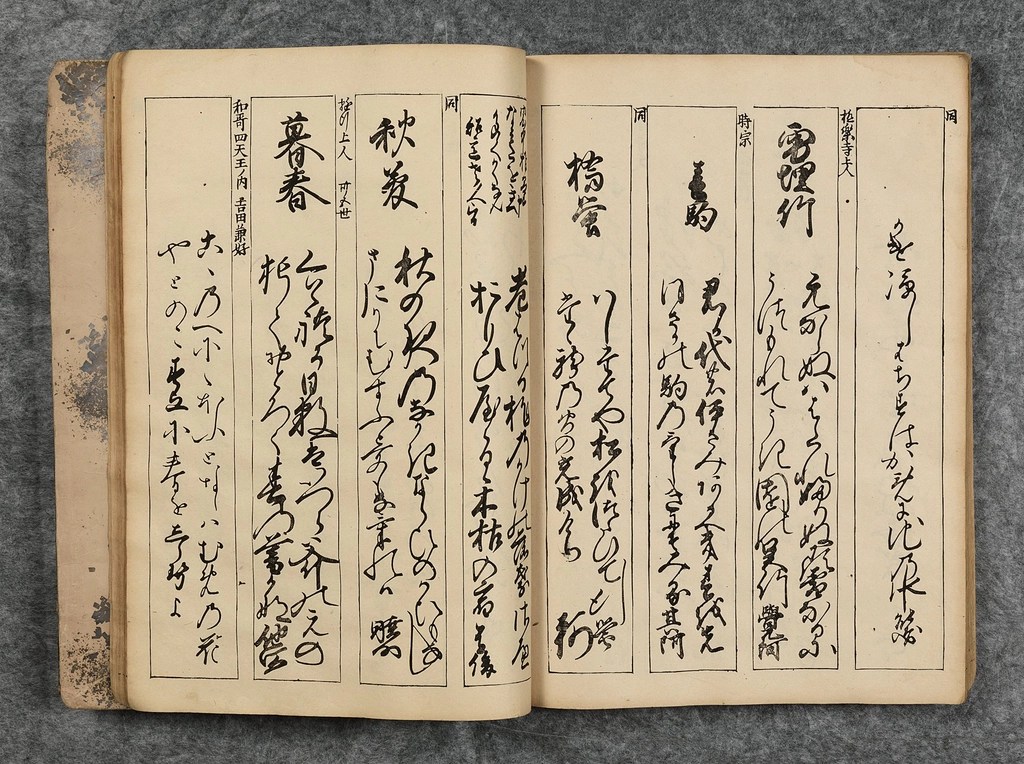
There are two directional writing styles common in Japan, either right-to-left whilst reading vertical lines from top-to-bottom or from left-to-right and along as we do in English. In publication, the style used is mostly a design choice, whilst in some cases, such as emails, only the English style may be possible (Trombley Jr. & Takenaka, 2015).
Relation to the spoken forms
Subject and Particle Dropping
As previously mentioned, Japanese often lacks a subject whilst English generally repeats it (Trombley Jr. & Takenaka, 2015). Similarly, Japanese particles are also dropped in casual conversation, for example, は and が in [私は]猫が好きです [watashi wa] neko ga suki desu [(I] like cats] becomes 猫好きです neko suki desu. (Trombley Jr. & Takenaka, 2015), where both the subject and particles are missing.
Despite what is previously mentioned, in spoken English, the subject can be dropped, as shown in “Did our sister research centre in Warrensville this morning (about 15 miles outside Cleveland). Did the same old talk about why we are here etc.” (Hardie, 2020, p. 1). In this example, subject ellipsis has occurred; the subject ‘I’ is omitted from both sentences and is implied through context.
Relation to Phonetic Readings
Both Japanese and English writing systems have derived from systems employed by foreign languages; the Japanese adopted the Chinese writing system (Sakade, 2013), and Christian missionaries brought across the 23-letter Roman alphabet (Crystal, 2003). As a result of this, both languages have complex relations between their written and spoken forms.
In English, there are more than 40 phonemes to be expressed by 26 letters; as a result, digraphs are used, which express one phoneme by two letters, for example, ‘sh’ for /ʃ/; therefore, English is not a purely phonetic language (Crystal, 2003). Moreover, vowels can be changed using the ‘magic e’ rule, such as in kit and kite (Crystal, 2003).
Furthermore, English spelling appears to be overly complex due to some frequent words having irregular spelling (Crystal, 2003). For example, Ghoti could be a spelling of fish as “the of fish sounds the same as the in cough, the is the same as the in women, and the is the same as the in motion” (Culpeper, Kerswill, Wodak, McEnery, & Katamba, 2018, p. 15). Therefore, phonological strategies to access the pronunciation of a word in English is difficult due to these phonetic irregularities (Tamaoka, 2014).
In contrast to English, Japanese Kana “share similar characteristics in terms of orthographic units and kana-to-sound mapping regularity. Kana represents the mora unit….each kana basically follows a one-to-one regular correspondence between a kana symbol and a mora unit” (Tamaoka, 2014, p. 442). As a result, kana words are pronounced the same as their spelling.
Alternatively, as stated by Sampson (2016), there is no relationship between Chinese Kanji graphs and the native Japanese pronunciation, a result of Japanese containing a large quantity of native vocabulary despite it being written with Chinese-derived scripts. However, as Sampson (2016) further explains, Kanji can contain a phonetic indication for Chinese pronunciations; for example, 味 [taste] in both languages is formed from the graphs 口 [mouth], and 未 [not yet], and in Chinese both 味 and 未 are pronounced wèi, but in Japanese 味 is pronounced aji and 未 mada. Therefore, Japanese kanji in such cases are solely logographic (Sampson, 2016).
Connected Speech
Pronunciation in connected speech is affected by the production of vowel and consonant segments, as they affect one another by processes of reduction and change (Crystal, 2003). For example, ‘was having’ in its citation form is /wɒzhaviŋ/ but undergoes reduction by the process of elision in connected speech, thus becoming /wəzaviŋ/. Similarly, Japanese pronunciation is also affected by these processes; the words でしたか deshita ka [was ] in its citation form is /deɕtaka/, but becomes /deɕtka/ in connected speech.
Conclusion
Japanese and English are exceedingly different languages; they differ in their sentence structures, layout and most significantly, their orthographic typologies (either pleremic or cenemic). Despite this, similarities persist through both using a cenemic writing system and in how they relate to their spoken forms, with both being prone to contextual subject dropping and the processes of reduction and change during connected speech.
References
{Ajalt}, A. f.-L. (1994). Japanese for Busy People (Vol. I). Tokyo, Japan: Kodansha International. Retrieved 2020
Aronoff, M., & Rees-Miller, J. (2003). The Handbook of Linguistics. Malden, Massachusetts, USA: Blackwell Publishers. Retrieved December 2020
Borgwaldt, S., & Joyce, T. (2013). Typology of Writing Systems. Amsterdam; Philadelphia: John Benjamins Pub. Co. Retrieved from https://ebookcentral.proquest.com
Coulmas, F. (2010). Writing Systems: An Introduction to Their Linguistic Analysis. Cabridge University Press.
Crystal, D. (2003). The Cambridge Encyclopedia of the English Language (Second Edition ed.). Cabridge, Unighted Kingdom: Cabridge Univeristy Press.
Culpeper, J., Kerswill, P., Wodak, R., McEnery, A., & Katamba, F. (2018). English Language: Decription, variation and context (2
nd ed.). London, United Kingdom: Macmillan Education UK. Retrieved 2021, from https://ebookcentral.proquest.com/lib/lancaster/reader.action?docID=6234918
DeFrancis, J. (1989). Visible speech: the diverse oneness of writing systems. Honolulu: University of Hawai’i Press.
DeFrancis, J. (2002). The ideographic myth. In M. S. Erbaugh, Difficult Chatacters: Interdisciplinary studies of Chinese and Japanese writing (1st ed., Vol. 6, pp. 1-20). Columbus, ational East Asian Language Resource Center, Ohio State Universit: National East Asian Language Resource Center, Ohio State University. Retrieved January 2021
Graddol, D., Leith, D., & Swann, J. (2000). English history, diveristy and change (2nd Edition ed., Vol. 1). (D. Graddol, D. Leith, & J. Swann, Eds.) London, Unighted Kingom: Routledge. Retrieved December 2020
Hardie, A. (2020, November 30). Lancaster University Moodle. Retrieved January 2021, from Lancaster Univeristy: https://modules.lancaster.ac.uk/course/view.php?id=30846
Sakade, F. (2013). A Guide to Reading and Writing Japanese: : a comprehensive guide to the Japanese Writing System (4th Edition ed.). (K. Henshall, C. Seeley, H. Groot, & J. Ikeda, Eds.) Vermont: Tuttle Publishing. Retrieved 2020
Sampson, G. (2016). Typology and the study of writing systems. Linguistic Typology, 20(3), 561-567. doi:https://doi-org.ezproxy.lancs.ac.uk/10.1515/lingty-2016-0027
Tamaoka, K. (2014, October). The Japanese Writing System and Lexical Understanding. Japanese Langauge and Literature, 48(2), 431-471. Retrieved January 2020, from https://www.jstor.org/stable/24394417
Trombley Jr., G., & Takenaka, Y. (2015). Japanese From Zero! 1. Folkestone, Kent, UK: Bay Foreign Language Books Ltd. Retrieved 2020


Leave a Reply