
According to Worden (1998), language must have evolved from cognitive capacities already present amongst our non-speaking ancestors due to an “evolutionary speed limit”. This essay describes several of these capacities, supported by evidence from primate cognition and behaviour. Capacities described (in order) include Theory of Mind (ToM), Conceptualisation, Imitation, Joint Attention & Gaze Tracking, Call Variants, Voluntary Control, Neuroanatomy: Ventral Premotor Cortex (VPC), Mirror Neurons, and Neocortical Volume. Primates are our closest living relatives and live in environments like our ancestors; therefore, their cognition and behaviours have changed less than our own, thus we assume similar cognition was present in our non-speaking ancestors (Burling, 2005).
ToM
Baron-Cohen (2012) proposes that ToM is a precursor for complex language. Dunbar (2004) defines ToM as the ability to recognise another individual’s intentions and beliefs (often described in ‘layers of intentionality’). Research suggests that some species of non-human primates possess a ToM; tactical deception yields many examples like the case of the chimpanzees Sherman and Austin. Researcher Savage-Rumbaugh (as cited in Dunbar, 2004) observed that Austin liked to frighten Sherman by making loud noises in the outdoor enclosure. After which, he would come inside and pretend to be scared, Sherman would become frightened, believing something to be outside. For Austin, this demonstrates three orders of intentionality ‘I think [1] that Sherman will think [2] that I think [3] there is something outside’. Baron-Cohen (2012) proposes that ToM is used for intentional communication and speech repairs (alongside teaching, persuasion, deception, plan formation, sharing attention, and pretending).
Intentional communication involves purposely trying to change the state of knowledge in another individual; this requires an awareness that other individuals have different beliefs to our own, thus a ToM (Baron-Cohen, 2012). Intentional communication is important for many aspects of language including the listed abilities above. ToM also enables language to be used for speech repairs as it allows us to infer a miscommunication has occurred, allowing us to rephrase sentences to improve understanding between speakers (Baron-Cohen, 2012). Therefore, ToM is an essential prerequisite for the development of typical communication.
Conceptualisation
Burling (2005) states that before we can use a word correctly, we need to have a concept of the referent we want to talk about; therefore, a concrete conceptual system is a precursor for language. For example, to use the word ‘dog’ you need to be able to distinguish it from other animals by holding a concept of what a dog is. Burling goes on to explain that chimpanzees are much better at holding narrower conceptualisations than other species. He discusses the case of the chimpanzee Zee who was able to sort objects such as buttons, nails, bolts etc. into discrete categories based on colour, shape, and length. Therefore Burling (2005) argued that chimpanzees have a finer-tuned conceptual system than other animals; he goes on to state that although language is not needed for such conceptualisations, language enables further categorizations to occur. Our ancestors would have needed rich conceptualisations to label all the objects in their environment (Burling, 2005).

Moreover, ‘referential calls’ have been found in Vervet monkeys who have different alarm calls dependent on the predator approaching. Cheney and Seyfarth (1990) (as cited in Carstairs-McCarthy, 1998), found alarm calls specified for snakes, eagles, and leopards which resulted in different behavioural responses. Scherer (1992) (as cited in Aitchison, 1998) argues that these calls portray the stage between human symbolisation and non-symbolic communication systems of the animal kingdom. Despite some species demonstrating their ability to form narrow conceptualisations, no other species other than humans show a desire to label everything (Aitchison, 1998). Selection pressures likely caused language to co-opt this capacity for narrower conceptualisation and labelling. Burling (2005) states words are essential for syntax to occur which enables a clearer understanding of utterances (see Call Variants).
Moreover, research has shown linguistic labelling of concepts enables faster reaction times. Winawer et al. (2007) ‘Russian Blues’ study demonstrated that category labels facilitate faster colour discrimination; discriminating faster towards stimuli in our ancestors’ environment heralds obvious survival benefits such as responding quicker to dangers or competitive resources.
Imitation
Imitation is the copying of another individual’s behaviour or vocalisations with the intention of achieving the same goal, whilst mimicry refers to only copying; although mimicry is important for language learning it is imitation that is imperative, making it a language precursor (Burling, 2005). Observations by Russon & Galdikas (as cited in Burling, 2005) found that, after watching humans, orangutans would manoeuvre logs to form a bridge across a stream. Whilst Boesch & Boesch -Achermann observed a chimpanzee mother teaching her daughter to crack nuts more effectively by using a tool which the daughter subsequently copied (as cited in Burling, 2005).
Primate imitation is also observed in vocalisations, Burling (2005) states that chimpanzees from different troops develop similar pant hoots when living together in captivity whilst Ujiheli (1998) explained how the song of a deceased male gibbon may be taken up by his widow. These examples demonstrate an ability to imitate and mimic behaviours, Burling (2005) argues that, within the animal kingdom, apes have the closest imitative ability to humans. According to Donald (2004), imitation provided a less efficient communication system upon which natural selection could act to develop language. For words to be learnt across generations, imitation requires the imitator to recognise similarities between the actions and vocalisations of others to themselves (Burling 2005).
Joint attention & Gaze Tracking
Another language prerequisite, joint attention, is necessary for us to communicate concepts such as objects or parts of an object to abstract notions such as love (Burling, 2005). Joint attention is defined as when a child and an adult are aware that they are focusing on the same thing (Baldwin, 1995, as cited in Akhtar & Gernsbacher, 2007). For children to learn a word and match it to a concept, both children and caregivers often employ pointing gestures or hold up items for inspection (Burling, 2005). Unlike humans, chimpanzees do not present joint attention in the wild unless calling attention to themselves and are still not able to do this as effectively as humans (Burling, 2005).
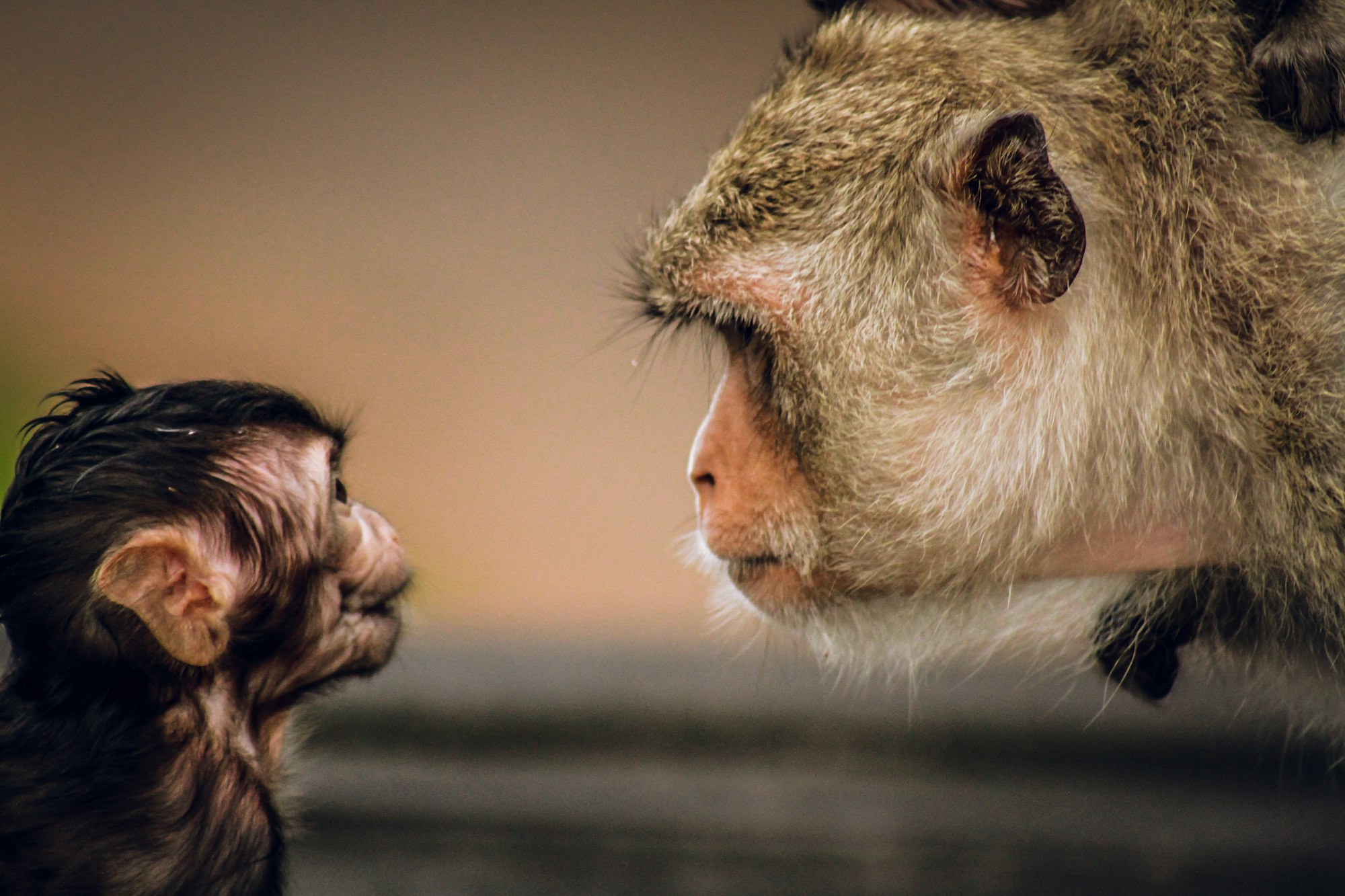
However, chimpanzees do demonstrate an ability for gaze tracking which is important for joint attention. Tomasello, Call, and Hare (1998) demonstrated gaze tracking in chimpanzees by engaging their attention by holding up a piece of fruit, this was done when one chimpanzee (conspecific) was facing the observation tower and another nearby chimpanzee (subject) was facing away from it. Once the conspecific’s attention was locked on the fruit, the subject then followed their gaze towards it. Burling (2005) states gaze tracking in chimpanzees is a prerequisite for joint attention, along with their basic ToM. These characteristics set chimpanzees closer than most mammals to our own cognition (Burling, 2005); we can assume that our non-speaking primate ancestors developed language from cognition like that present in our closest primate cousins (Burling, 2005)
Call Variants
Language users employ syntax to enable listeners to better understand by discerning relationships between words (Vigliocco, 2000). Language is formed from complex sequences of meaningless and meaningful units (phonological & lexical syntax); an intermediary evolutionary stage between non-syntactical and syntactical language is found in non-human primates (Ujiheli, 1998). Chimpanzees and bonobos recombine and break-down calls to form alternative meanings (Ujheli, 1998). These ‘long (compound) calls’ are formed from small segments of distinguishable units which hold ‘traditional’ call functions (e.g., alarm calls), and are combined in different patterns (lexical syntax); chimpanzees also insert uniquely located acoustic features into their calls (phonological syntax) (Ujiheli, 1998).
These call variations distinguish the vocalisations of group members; such member recognition becomes more important with increasingly complex social structures (Ujheli, 1998). Arguably, these complex social groups selected for phonological syntax; the subhuman level of phonological syntax presented above does not enable freely combinable call-variants although it remains a precursor for the evolution of phonemes (Ujiheli, 1998). Phonological syntax (phoneme recombination) enables language to have a larger repertoire of vocabulary (Burling, 2005). Alternatively, primate lexical syntax does exhibit free combination, but it is limited to the few ‘traditional calls’(Ujiheli, 1998). Bickerton (1998) argues sexual selection for better communicators caused lexical syntax to evolve, reducing ambiguities in rapidly spoken complex utterances. Despite some syntactical abilities, primate species cannot form sequences of calls into sentences but present an intermediary evolutionary stage important for sentence understanding, member recognition and phoneme production (Ulbaek, 1998).
Voluntary control

Burling (2005) explains that voluntary control over the vocal tract is essential for language; with the increasing importance of vocalisations, increased vocal control is selected for. Aitchison (1998) explains that mostly automatic vocalisations are made by primates whilst humans exhibit some voluntary control. However, research has demonstrated cases of voluntary control in primates. Cheney & Seyfarth (as cited in Burling, 2005) describe a case in vervet monkeys where alarm calls for predators are more likely to be conducted in the presence of kin. Unlike other primates, humans have complete control over their vocal tract apart from gesture-calls such as smiling, laughing, and gasping which can be involuntary; we can assume that an equivalent amount of voluntary control over human gesture-calls is present in vervet alarm calls (Burling, 2005).
Moreover, copulation calls in some species of primates can be suppressed when females are mating with lower-ranking males (Byrne & Whiten, 1992, as cited in Hurford, 2007). Studdert-Kennedy (1998) states that distinct protosyllables needed for the evolution of language required modulation of their acoustic properties. Hauser et al. (1996) (as cited in Studdert-Kennedy, 1998) found that changes in jaw and lip configuration in rhesus monkeys caused modulation in their calls. Such modulations are a step towards syntactic properties (see call variants) and thus, language, requiring increased voluntary control. Furthermore, an increasing vocabulary repertoire selects for vocal control to enable the efficient use of a larger quantity of sounds to distinguish words (Burling 2005).
Neuroanatomy
VPC
All the previously mentioned capacities are forms of social intelligence, if language evolved from them then the brain regions specified for language should be near areas specialised for social intelligence (Worden, 1998). Damasio (1994) (as cited in Worden, 1998) demonstrated that some emotional and social behavioural abnormalities are caused by lesions located in the prefrontal cortex (Worden, 1998) In monkeys, the VPC (F5 region) is involved with the physical aspects of imitation, but the rostral part is homologous with Broca’s area (Rizzolatti & Arbib, 1998). In humans, Broca’s area which is specialised for language use (see Musso et al., 2003) overlaps with the human VPC; activity related to verb usage and other semantically complex language aspects overlap more with the VPC than that of auditory aspects (Worden, 1998). This clear link between language and social intelligence’s localisation in the VPC supports the idea that language evolved from social intelligence (Worden, 1998).
Mirror Neurons

As previously mentioned, imitation is necessary for language, but the presence of mirror neurons is a prerequisite for imitation (Burling, 2005). Mirror neurons fire when performing an action or when observing others perform known actions (Burling, 2005); they fire when monkeys enact ‘grasping’ behaviour or when observing grasping in others (Arbib, 2003). Research on human brains has also found mirror systems in a similar area to that of monkeys. Rizzolatti et al. (1996) (as cited in Arbib, 2003) used PET scans to reveal that grasping tasks caused activation of the Broca’s area in human brains; Massimo Matelli (as cited in Rizzolatti & Arbib, 1998) argues that Broca’s area is homologous to the F5 region in monkey brains. Arbid (2003) outlines three ways in which a mirror-system services language; it enables individuals to learn by imitation, social interaction, and self-correction. It is argued that Broca’s area, specialised for language in humans, was co-opted from its original function of understanding and producing motor acts (Rizzolatti et al., 1995, as cited in Arbid, 2003). This manual-gesture based mirror-system is seen as a proto-Broca’s area enabling a ‘prelanguage’ to emerge (composed of gestures and orofacial expressions), eventually adapting to have primary control over the vocal anatomy (Arbid, 2003).
Neocortical volume
Another language prerequisite is a neocortical volume that enabled a larger group size. Dunbar (1993) states that there is a relationship between increasing primate group size and increasing neocortical volume. He also describes a linear relationship between primate group size and time spent maintaining relationships through ‘grooming’; any groups that do not meet the expected grooming time for their size undergo fission. He states that social interaction can occupy up to 20% of primate activities. However, Wrangham (1986) (as cited in Dunbar, 1993), found resting and socialising activities can occupy up to 43% of a chimpanzee’s time; this is feasible as 20% of this is expected for grooming and the remaining 23% does not impose an unfeasible time-budget constraint.
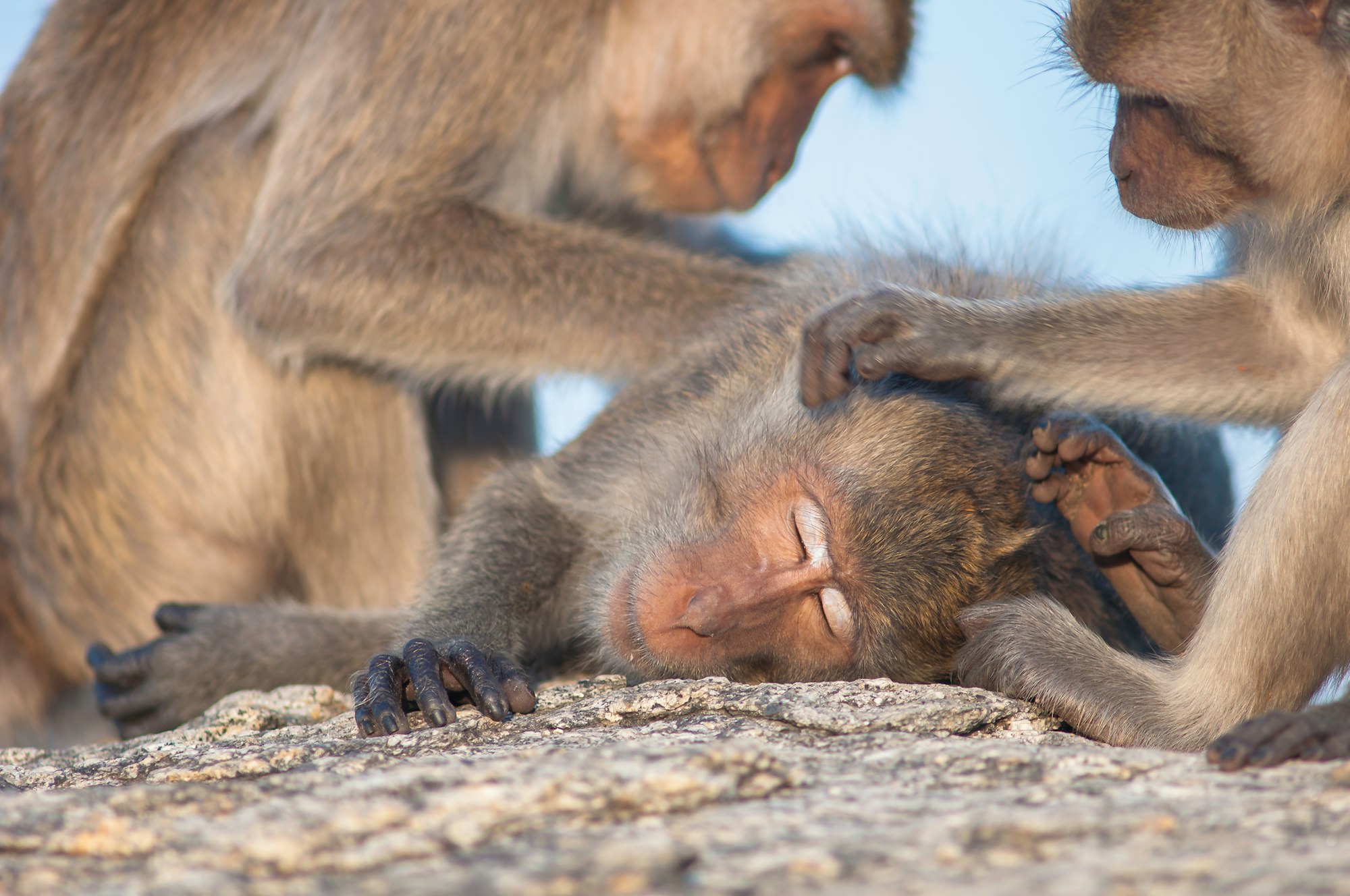
However, human group size (predicted by neocortex volume) equates to 150-200 individuals. Forge (1972) (as cited in Dunbar, 1993) supports this, finding the maximum population that could be maintained for New Guinea Neolithic settlements without adopting a hierarchal or policing structure was 150 individuals. Moreover, the smallest units within modern armies have a maximum number of 200 individuals (with assistance from modern technologies), suggesting this is the maximum number of people possible to function efficiently as a team (Dunbar, 1993). This ideal group size equates to an unfeasible time-budget constraint of 62% expected grooming time. However, reducing group size is not always possible as environmental factors determine the minimum group population (Dunbar, 1993). Therefore, language evolved as a time-efficient bonding mechanism to maintain group cohesion; language facilitates bonding behaviour with three people at once, enabling us to maintain relationships with approximately 150 individuals (Power, 1998). Moreover, it enables us to better categorise unknown individuals into a social hierarchy, in which offence can be prevented by following expected etiquette behaviours (Dunbar, 1993).
Conclusion
In conclusion, this essay has covered some of the key socio-cognitive capacities that were likely to have been in place prior to the evolution of language. Using evidence from non-human primate behaviour, I have discussed the importance of ToM, conceptualisation, imitation, joint attention and gaze tracking, call variants, voluntary control, and aspects of Neuroanatomy. However, researchers differ in their arguments for which capacities hold the most importance. Burling (2005) outlines five essential cognitive capacities whilst Worden (1998), argues that social intelligence extended to form a ToM and it is ToM which was co-opted for language. Further research should aim to agree upon a set of core cognitive capacities and standardise an evolutionary model for language.
References
Aitchison, J. (1998). On discontinuing the continuity-discontinuity debate. In J. R. Hurford, M. Studdert-Kennedy, C. Knight (Eds.), Approaches to the evolution of language: Social and Cognitive Bases (pp. 20-22). Cambridge, New York: Cambridge Univ. Press.
Akhtar, N., & Gernsbacher, M. A. (2007). Joint attention and Vocabulary Development: A Critical Look. Language and Linguistics Compass, 1(3), 195-207. doi:10.1111/j.1749-818x.2007.00014.x
Arbib, M. A. (2003). The Evolving Mirror System: A Neural Basis for Language Readiness. In 2290526179 1565707025 M. H. Christiansen & 2290526180 1565707025 S. Kirby (Authors), Language evolution (pp. 182-200). Oxford: Oxford University Press. doi:10.1093/acprof:oso/9780199244843.003.0010
Baron-Cohen, S. (1999). Evolution of a theory of mind. In M. C. Corballis & S. E. G. Lea (Eds), The descent of mind: Psychological perspectives on hominid evolution (pp. 261–277). doi:10.1093/acprof:oso/9780192632593.003.0013
Bickerton, D. (1998). Catastrophic Evolution. In J. R. Hurford, M. Studdert-Kennedy, C. Knight (Eds.), Approaches to the evolution of language: Social and Cognitive Bases (pp. 350-353). Cambridge: Cambridge Univ. Press.
Burling, R. (2005). The talking ape: How language evolved. Oxford: Oxford University Press.
Carstairs-McCarthy, A. (1998). Synonymy avoidance, phonology and origin syntax. In J. R. Hurford, M. Studdert-Kennedy, C. Knight (Eds.), Approaches to the evolution of language: Social and Cognitive Bases (p. 288). Cambridge, New York: Cambridge Univ. Press.
Donald, M. (1998). Mimesis and the Executive Suite: Missing links in language evolution. In J. R. Hurford, M. Studdert-Kennedy, C. Knight (Eds.), Approaches to the evolution of language: Social and Cognitive Bases (pp. 60-62). Cambridge, New York: Cambridge Univ. Press.
Dunbar, R. (1993). Coevolution of neocortical size, group size and language in humans. Behavioral and Brain Sciences, 16(4), 681-735. doi:10.1017/s0140525x00032325
Dunbar, R. (2004). Grooming, gossip and the evolution of language (2nd ed.). London, England: Faber and Faber.
Musso, M., Moro, A., Glauche, V., Rijntjes, M., Reichenbach, J., Büchel, C., & Weiller, C. (2003). Broca’s area and the language instinct. Nature Neuroscience, 6(7), 774-781. doi:10.1038/nn1077
National Autistic Society. (n.d.). What is autism? Retrieved December 22, 2022, from https://www.autism.org.uk/advice-and-guidance/what-is-autism?gclid=CjwKCAiAnZCdBhBmEiwA8nDQxbZNGF4ttWYOCsvKPckCACOZ5yaBl9YbqIHV6FV73_I3T2TkVBvTYxoCd5UQAvD_BwE
Power, C. (1998). The Gossip Hypothesis. In J. R. Hurford, M. Studdert-Kennedy, C. Knight (Eds.), Approaches to the evolution of language: Social and Cognitive Bases (p. 113). Cambridge, New York: Cambridge Univ. Press.
Rizzolatti, G., & Arbib, M. A. (1998). Language within our grasp. Trends in Neurosciences, 21(5), 188-194. doi:10.1016/s0166-2236(98)01260-0
Studdert-Kennedy, M. (1998). The particulate origins of language generativity. In J. R. Hurford, M. Studdert-Kennedy, C. Knight (Eds.), Approaches to the evolution of language: Social and Cognitive Bases (pp. 208-209). Cambridge, New York: Cambridge Univ. Press.
Tomasello, M., Call, J., & Hare, B. (1998). Five primate species follow the visual gaze of Conspecifics. Animal Behaviour, 55(4), 1063-1069. doi:10.1006/anbe.1997.0636
Ujhelyi, M. (1998). Long-call structure in apes as a possible precursor for language. In J. R. Hurford, M. Studdert-Kennedy, C. Knight (Eds.), Approaches to the evolution of language: Social and Cognitive Bases (pp. 177-187). Cambridge, New York: Cambridge Univ. Press.
Ulbaek, I. (1998). The origin of language and cognition. In J. R. Hurford, M. Studdert-Kennedy, C. Knight (Eds.), Approaches to the evolution of language: Social and Cognitive Bases (pp. 30-36). Cambridge, New York: Cambridge Univ. Press.
Vigliocco, G. (2000). Language processing: The anatomy of meaning and syntax. Current Biology, 10(2), R78-R80. doi:10.1016/s0960-9822(00)00282-7
Winawer, J., Witthoft, N., Frank, M. C., Wu, L., Wade, A. R., & Boroditsky, L. (2007). Russian blues reveal effects of language on color discrimination. Proceedings of the National Academy of Sciences, 104(19), 7780-7785. doi:10.1073/pnas.0701644104
Worden, R. (1998). The evolution of language from social intelligence. In J. R. Hurford, M. Studdert-Kennedy, C. Knight (Eds.), Approaches to the evolution of language: Social and Cognitive Bases (pp. 148-156). Cambridge, New York: Cambridge Univ. Press.
 Waygaze
Leave a comment